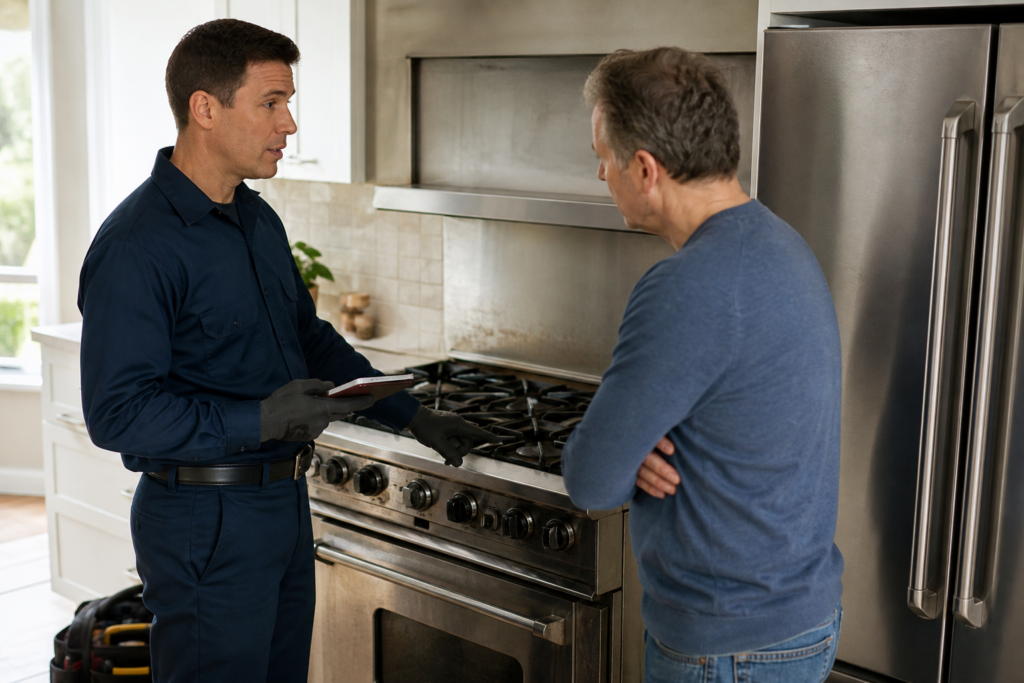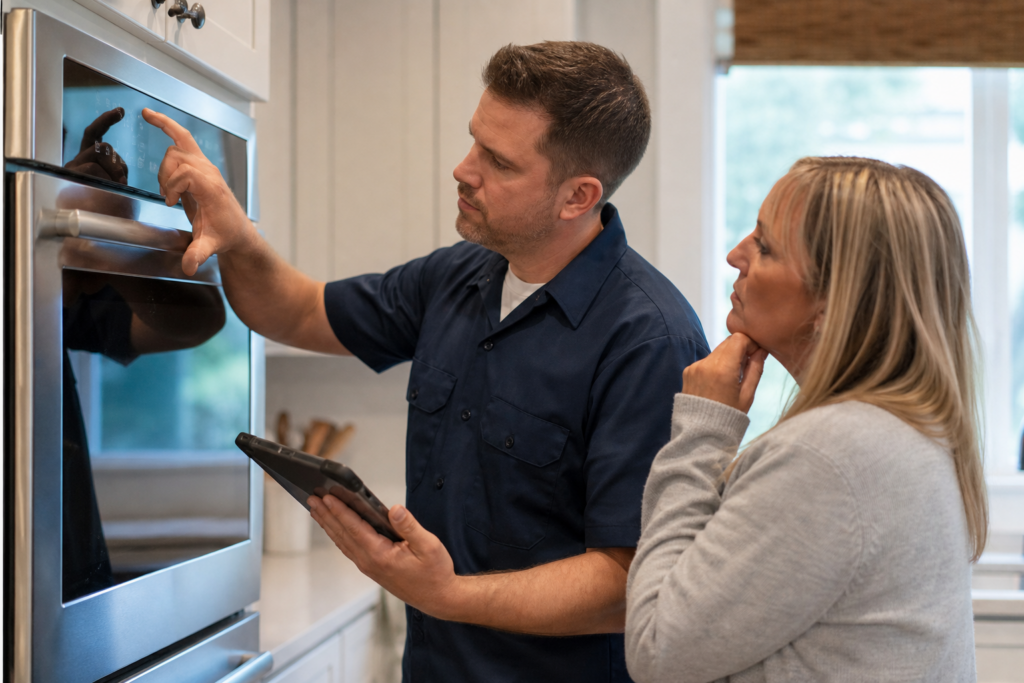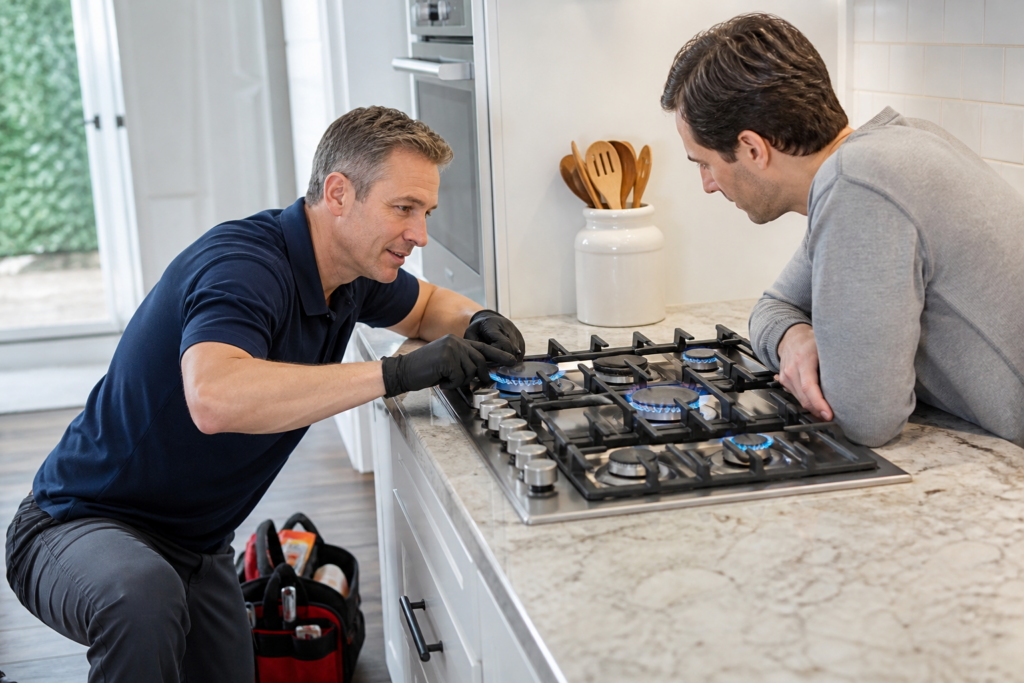
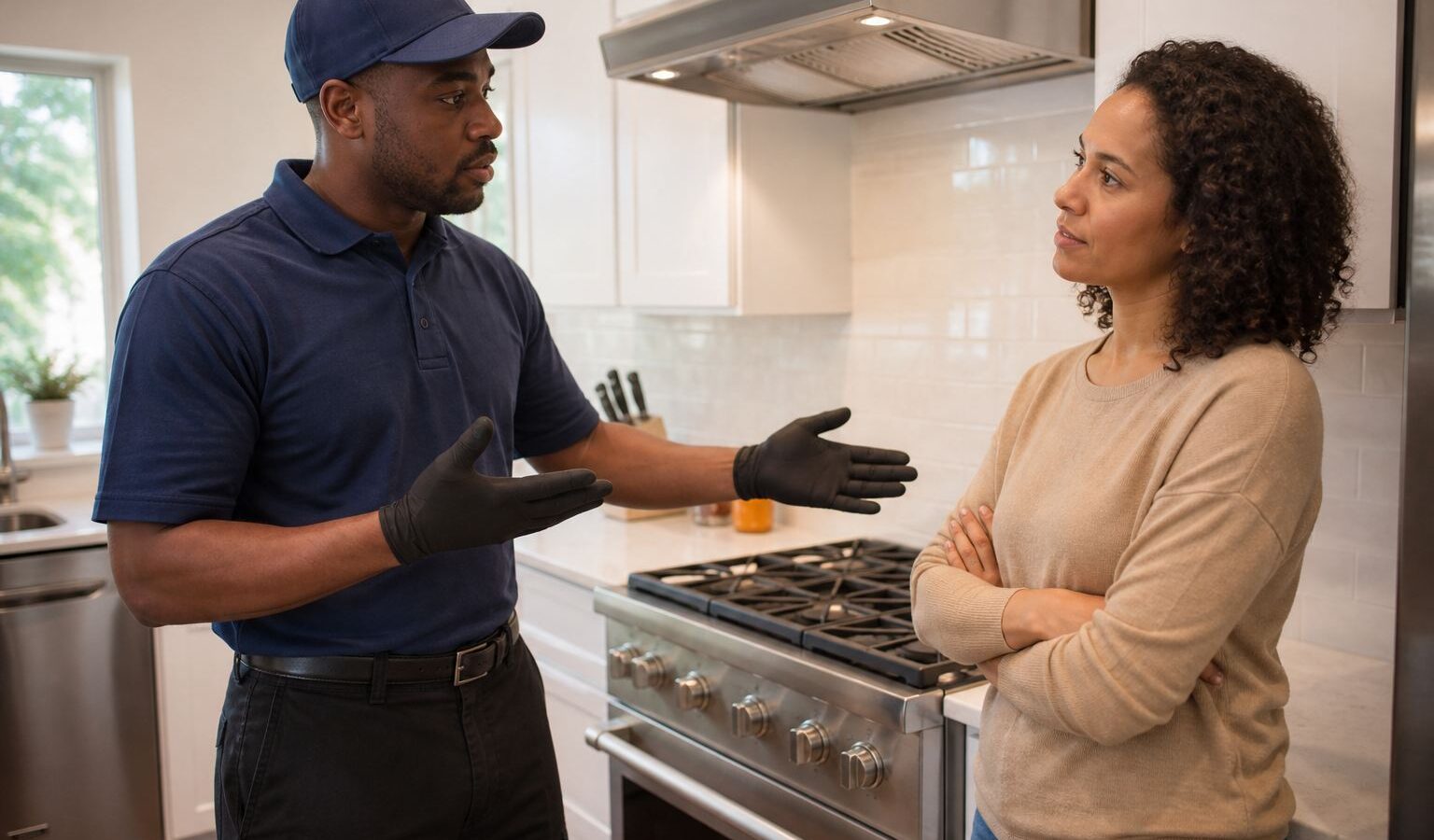
A clear line between safe checks and repairs that belong to a qualified technician.
Stop any homeowner repair that involves removing panels, bypassing a safety device, gas connections, live electrical testing or a sealed cooling system. Routine owner care is limited to what the use-and-care manual describes, such as cleaning approved filters, and anything beyond that belongs with a trained technician.
Knowing exactly where owner repairs end is easier before something goes wrong in the middle of a busy week. A symptom alone does not name a failed part, so rely on observations that are safe and repeatable and that will help if you later arrange a repair visit.
Routine care sits on one side and anything involving testing or disassembly on the other. Locks, safety switches and error messages are not to be bypassed just to keep an appliance in use. Writing a few things down early helps whoever diagnoses the problem reach the answer faster and with fewer errors.
Before attempting any routine check, decide whether the problem involves heat, electricity, gas, water near wiring or a sealed cooling system. Keep the appliance where it is and do not force panels, fittings or controls. If a simple adjustment changes the result, run one normal cycle or operation before concluding anything. Treat water close to an outlet or plug as a reason to stop, not as something to troubleshoot.
Pulling a panel, defeating a safety device or taking a live measurement turns a task into one that owners should not attempt. Also keep track of when it appears: each time, only with a certain load or setting, or after running a while. That pattern is worth more than restarting the appliance.
| Warning sign | Response | Do not |
|---|---|---|
| Smell of burning | Stop using it | Open the appliance |
| Smell of gas | Leave the area and call your gas provider | Flip any switch |
| Water near an outlet | Cut power safely | Touch a wet plug |
Manufacturer manuals draw the line at maintenance: cleaning filters, wiping seals, descaling with the recommended product and checking visible connections. A manual for one Bosch dishwasher tells you to clean the filters yourself but, for the drain pump, assumes you unplug the machine and take care around sharp debris such as glass. Even documented tasks carry risk, so skip any step you are not comfortable with.
Two things should always stay off the owner list: opening a panel that needs tools, and anything done with the appliance live. Heating circuits, control boards, gas valves and refrigerant lines hold energy or pressure that is not obvious from outside.
Model-specific controls, filter access and service intervals are spelled out in the use-and-care manual, so keep it close. Restrict cleaning to the parts it marks as user-serviceable, use only the products it recommends, and make sure each piece you take off goes back as designed.
Ahead of any further attempt, clear blockages, lighten a very heavy load and confirm nothing is limiting airflow, the water supply or the door’s clearance. Repeated resetting is best avoided: an intermittent fault can hide behind it, and water, heat or pressure may end up where it should not.
The use-and-care manual for one Bosch oven describes a single reset at the circuit breaker for a locked door, and another describes cutting power to a cooktop for a short time when a fault code is not listed. Those are documented one-time steps, and the manuals say to give the code to customer service if it returns. Repeating a reset, or using one as a general troubleshooting method, can hide a fault that needs testing.
The Bosch US dryer pages say to unplug the dryer before cleaning the interior, sensor or condenser. The common thread is that power is removed first, the task is the one the manual names, and the part is dry and replaced as it was. Use that pattern as a test before attempting something you saw online.
What owners may try
Technician-only work
Where the simple checks change nothing, stop at what a homeowner can serviceably do. Anything touching internal wiring, heating circuits, pumps, motors, control boards, gas connections or refrigerant lines belongs with a technician who has the correct test equipment and can verify the repair safely.
Call for service quickly when things are deteriorating, a breaker trips, water gets near electrical parts, something smells burnt or hot, a grinding noise is new, or a normal cycle cannot finish. Stop using any appliance that displays a safety warning.
When in doubt, shutting off the supply is the safe move: the breaker for electrical concerns, the water valve for leaks, and walking away from a gas smell. Do that first, then describe what you saw. Stopping early costs a short wait, while continuing can cost far more in damage or injury.
Pass along the model number, the exact symptom, when it began, the selected settings and the outcome of each safe check listed above. Photographing a code or describing a noise briefly is welcome, but no cover should be taken off to do so.
Not as a homeowner check. Panels cover wiring, hot parts and moving parts. Describe the symptom and let a technician decide what needs to be opened.
Leave the area and call your gas provider from a safe distance. Do not operate switches or appliances while you are in the space.
Write down the code first. If it returns after one documented reset, stop using the appliance and arrange service, especially when water, heat or burning smell is involved.
Careful notes are not a fix, though they make a sound starting point. Work through the simple conditions, preserve whatever error information appears, and refer anything involving power, gas, sealed systems or internal mechanics to a qualified appliance technician.
Oven not heating, uneven baking, or showing an error? We diagnose Bosch oven faults with a safety-first approach.
Induction or electric cooktop not heating or responding? We diagnose Bosch cooktop faults safely and precisely.
Bosch oven diagnostics and repair — heating, temperature accuracy and error codes.
Bosch cooktop diagnostics and repair — induction detection, heating and control faults.
A single key is registering as continuously pressed. Check the panel, reset power, then book service.
Identify whether the symptom involves heat, electricity, gas, water near wiring, or a sealed cooling system before attempting any routine check.
Only if there is no burning smell, smoke, sparking, gas odor, water near electricity, or other safety warning. Otherwise stop and arrange service.
The cheapest repair is not automatically the best decision, and replacement is not automatically smarter because an appliance has several years of use.
An error code is a starting point. The same code can describe a system condition without identifying the exact failed part.
A gas flame that suddenly changes shape can be caused by burner cleanliness and cap position, but color and stability can also point to…
Share a few details and we’ll confirm an appointment. Prefer to talk? Call us and we’ll help right away.
Use the secure scheduler below to request your appointment.