
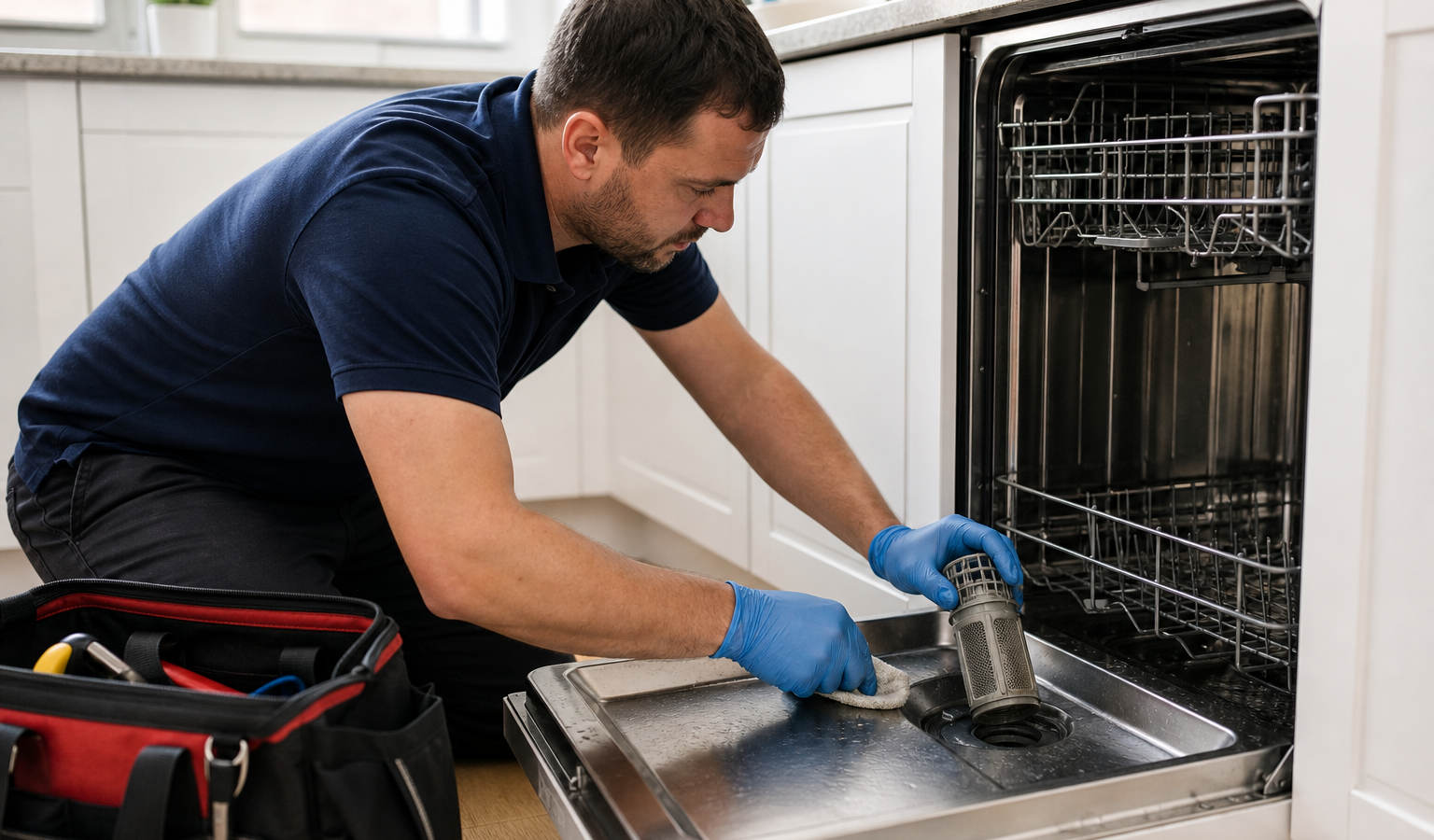
Dishwasher odor usually develops where food residue and moisture stay together: the filter, sump area, door edge and gasket.
A dishwasher odor usually comes from food residue sitting where water also stays, mainly in the filter, the bottom of the tub, the door edge and the gasket. Clean the filter, wipe those surfaces and run a cleaning cycle with a cleaner the manual approves; if the smell returns or water stands in the tub, book a diagnosis.
Dishwasher odor usually develops where food residue and moisture stay together: the filter, sump area, door edge and gasket.
A useful Bosch repair guide should narrow the problem before it narrows the part. Start with what you can observe from the outside: temperature, water level, sound, cycle stage, control response, loading, airflow, or the exact error shown on the display. Those details are more reliable than a guess made from one symptom.
Bosch support says the filter sits at the bottom of the tub and needs regular cleaning, and also advises cleaning the filter and spray arms every few months and using a Bosch dishwasher cleaner and descaler a few times a year. The use-and-care manual for one model recommends checking the filters for residue after each wash.
That manual describes a three-part filter system with a micro, a fine and a coarse filter, and mentions a dirt rim between the coarse and fine filter that also needs cleaning. Residue in that rim is easy to miss and can hold odor.
Clean the filter on schedule and wipe residue from user-accessible door and gasket surfaces. Wipe the bottom edge of the door and the gasket crease, where food and water meet.
Check that the dishwasher is actually draining at the end of the cycle instead of leaving dirty water behind.
Use the cleaning cycle and approved cleaner described for the model rather than mixing household chemicals.
Pre-rinsing dishes heavily does not prevent odor. The manual explains that it can make the sensors choose a lighter cycle, which may leave stubborn remnants behind, and advises removing only large food pieces.
Make one change at a time. If you reset settings, clean several components, and change the load all at once, you lose the information about which condition mattered.
Odor combined with standing water, repeated drain errors or a leak is no longer just a cleaning problem.
A technician can check the drain path and the pump area, where food and sharp debris can collect. The manual for one model warns that glass may be present when the drain pump area is cleaned, which is one reason that job is better left to service unless the manual’s own steps are followed carefully.
If the filter is badly clogged, the manual’s approach is to remove it, rinse it under running water and reassemble it so the arrows line up. A filter that is not seated correctly can leave water and food behind, so check that it is fitted properly before you run the next cycle.
Maintenance cannot repair a failed control, motor, heater, sensor, gas valve, or sealed refrigeration component. If the same symptom returns after the maintenance step, move to diagnosis.
| What you notice | What it can point to | What you can check |
|---|---|---|
| Musty smell after a cycle | Residue in the filter area or gasket | Clean the filter and wipe the gasket |
| Smell with water left in the tub | A drain problem | Check the drain hose and the filter |
| Smell only when the door is closed | Moisture trapped in seals and edges | Leave the door slightly open after use |
| Smell and cloudy film on dishes | Detergent residue or hard water | Follow the manual’s cleaning and rinse-aid guidance |
| Odor returns right after cleaning | Something beyond routine cleaning | Book a diagnosis |
Bosch says all its dishwashers use condensation drying: the final rinse heats the dishes, and the cooler stainless tub makes moist air condense and drain away. The manual for one model says a wet tub after the cycle is not an error. Droplets run off the walls and are pumped out, so moisture alone is not a sign of a fault.
Standing water that remains in the tub is different. It sits in the sump and can smell, and it signals a drain issue rather than a cleaning one.
Use the cleaner and cycle your manual describes, and do not combine household chemicals in the dishwasher. If you are unsure which product suits your model, check the manual.
Write down the full model number and a one-sentence description of what changed. If the issue comes and goes, include the condition that makes it appear. Do not move a built-in appliance, remove electrical panels, or disconnect gas components unless the service team specifically instructs you to do so.
The manual for one model says to check the filters for residue after each wash, and Bosch support recommends regular cleaning. The right interval depends on how much food ends up in the tub.
Not by itself. A smell can point to residue that needs cleaning, but a smell with standing water or repeated drain codes suggests a drain problem.
Bosch support recommends its own dishwasher cleaner and descaler a few times a year. Use what your manual approves and avoid mixing products.
The cheapest repair is not automatically the best decision, and replacement is not automatically smarter because an appliance has several years of use.
An error code is a starting point. The same code can describe a system condition without identifying the exact failed part.
A gas flame that suddenly changes shape can be caused by burner cleanliness and cap position, but color and stability can also point to…
Share a few details and we’ll confirm an appointment. Prefer to talk? Call us and we’ll help right away.
Use the secure scheduler below to request your appointment.