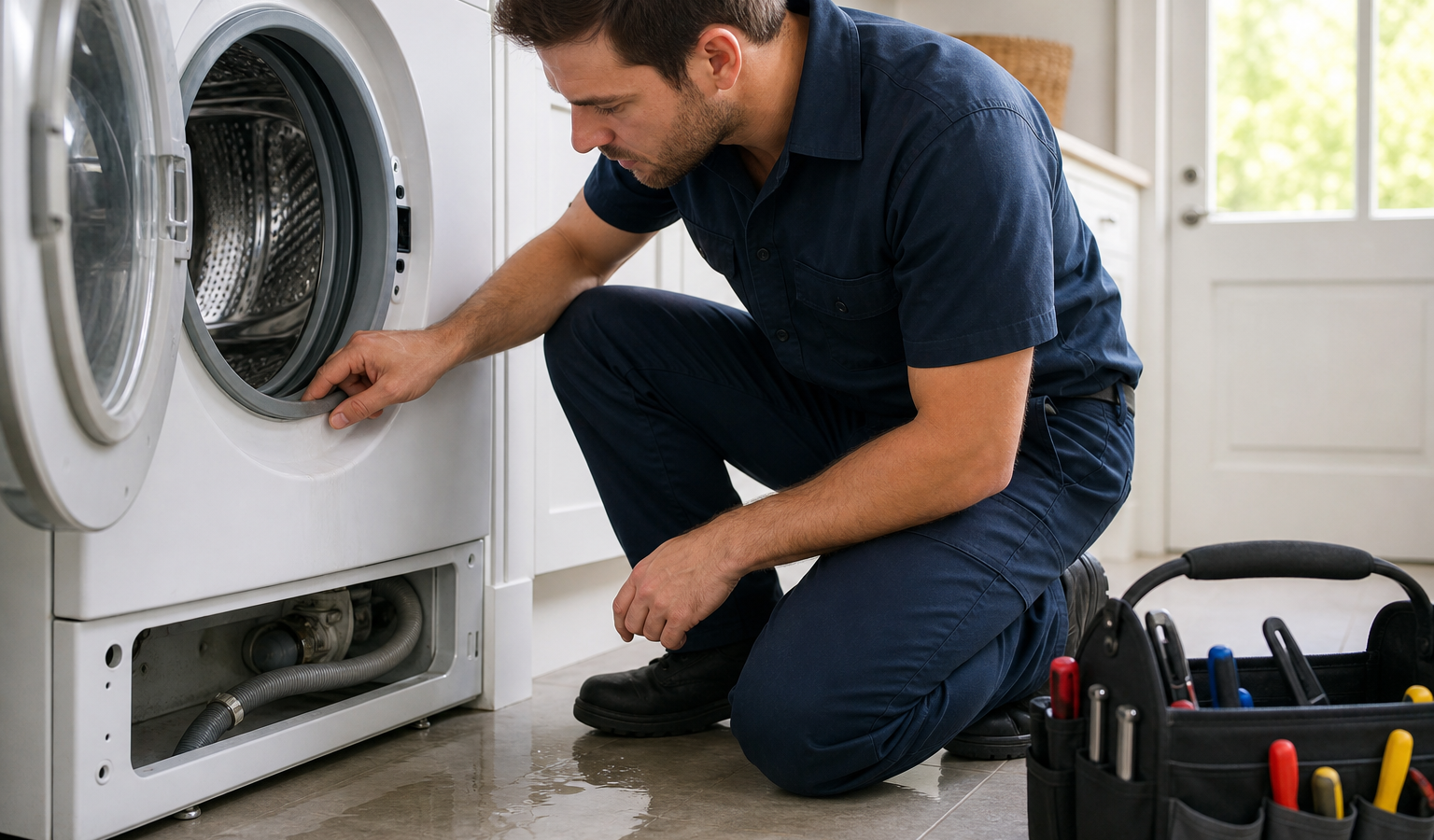
The location and timing of a washer leak usually narrow the possibilities faster than the size of the puddle.
Where and when the water appears usually tells you more than how much of it there is. Water at the door or detergent drawer often points to detergent, suds or seal contact, while water under the cabinet or from an internal hose needs service. If you are unsure, turn off the supply tap and stop running loads.
The location and timing of a washer leak usually narrow the possibilities faster than the size of the puddle.
A useful Bosch repair guide should narrow the problem before it narrows the part. Start with what you can observe from the outside: temperature, water level, sound, cycle stage, control response, loading, airflow, or the exact error shown on the display. Those details are more reliable than a guess made from one symptom.
Bosch support says where water pools is a clue to the cause. The causes it lists include a dirty contact area on the door seal and too much or old detergent coming from the drawer. Both are things you can see and clean without opening the machine.
The manual for one Bosch front-load washer says to use only HE detergent. Too much detergent or non-HE detergent causes suds, slow draining, foam from the drawer and the E:18 code, while too little can gray laundry. So a leak that appears with a heavy-suds load is different from a leak that appears at every wash.
Look for water at the door seal, detergent drawer, visible supply hoses and the external drain hose. Wipe the door seal contact area dry before a test load so any new water is easier to spot.
Check whether excessive detergent created heavy suds that pushed moisture toward the door or dispenser.
Note whether the leak happens during filling, tumbling, draining or high-speed spin. A leak that starts only after a move or a new installation also deserves a look at the hose connections.
Seal care matters too: Bosch support suggests wiping with a soft damp cloth and avoiding abrasive and chlorine cleaners that can degrade the rubber.
Make one change at a time. If you reset settings, clean several components, and change the load all at once, you lose the information about which condition mattered.
A leak from underneath the cabinet, an internal hose or any water near electrical parts requires service. Do not keep running full loads to reproduce it.
An internal leak can reach wiring and the floor underneath without being visible at the door. Shut off the supply tap, unplug the washer if you can reach the plug safely and arrange service rather than running another load to see what happens.
The manual also recommends cleaning the water inlet strainers if the water supply slows, and advises checking the drum for debris after each load. Neither step requires opening the cabinet, and each can rule out simple causes first.
A technician can then test the relevant electrical, mechanical, water, gas, or refrigeration system instead of starting with a generic parts guess.
| Where and when | What it can point to | What you can check |
|---|---|---|
| Water at the door edge | Dirty seal contact area or heavy suds | Wipe the seal and check the detergent amount |
| Foam or water at the dispenser drawer | Too much or non-HE detergent | Use HE detergent in the amount on the label |
| Wet floor near the tap or hose | Supply hose or connection | Look at the visible hose and turn off the tap |
| Water at the drain hose connection | External drain path | Check the hose is seated at the standpipe |
| Water from underneath the cabinet | Internal hose or part | Stop using the washer and book service |
Bosch support describes the E23 or F23 code as the AquaStop hose having been activated, and says not to use the washer and to turn off the water tap right away. If that appears with water on the floor, treat the leak as a service matter.
The manual also covers draining: if the washer fails to drain, the drain pump can be cleaned through its service cover, but it warns that water can come out and the impeller must turn freely. That is a manual-documented maintenance task, not a casual fix, and unplugging the washer comes first.
A leak during filling points toward supply, during tumbling toward the door, and during draining toward the drain path. Telling the person who books service which stage produces water saves guesswork.
Write down the full model number and a one-sentence description of what changed. If the issue comes and goes, include the condition that makes it appear. Do not move a built-in appliance, remove electrical panels, or disconnect gas components unless the service team specifically instructs you to do so.
Bosch support lists a dirty seal contact area and too much detergent. Wipe the seal gently and use HE detergent in the correct amount.
Yes, excess suds can foam out of the drawer or push water toward the door. The manual says too much detergent also causes slow draining.
Bosch support says the AquaStop hose has been activated. Do not use the washer and turn off the water tap right away.
A gas flame that suddenly changes shape can be caused by burner cleanliness and cap position, but color and stability can also point to…
A dishwasher leak should be described by when and where it appears. Water at the front during filling is different from water under the…
Recurring frost is usually a moisture story: humid air is getting into a place that should stay cold and dry, or defrost water is…
Share a few details and we’ll confirm an appointment. Prefer to talk? Call us and we’ll help right away.
Use the secure scheduler below to request your appointment.