Standing water after a cycle usually points to a drainage restriction. Here is what you can safely check.
For a Bosch dishwasher that is not draining, first check the filter and the visible drain hose and look at whether the symptom comes with a code. Manuals for some Bosch models say not-draining codes can come from a garbage disposal plug, a kinked hose or a missing high loop rather than a failed pump.
Water left standing in the tub disrupts the kitchen routine quickly. Still, a symptom alone cannot point to a failed part, which is why the first steps should be safe, repeatable and worth reporting if you later book a repair visit.
Think of the next steps as two groups: ordinary owner care, and tasks that need testing or taking the dishwasher apart. A lock, a safety switch or an error message must never be worked around to keep the machine going. Brief notes made now speed up the diagnosis later and make it more accurate.
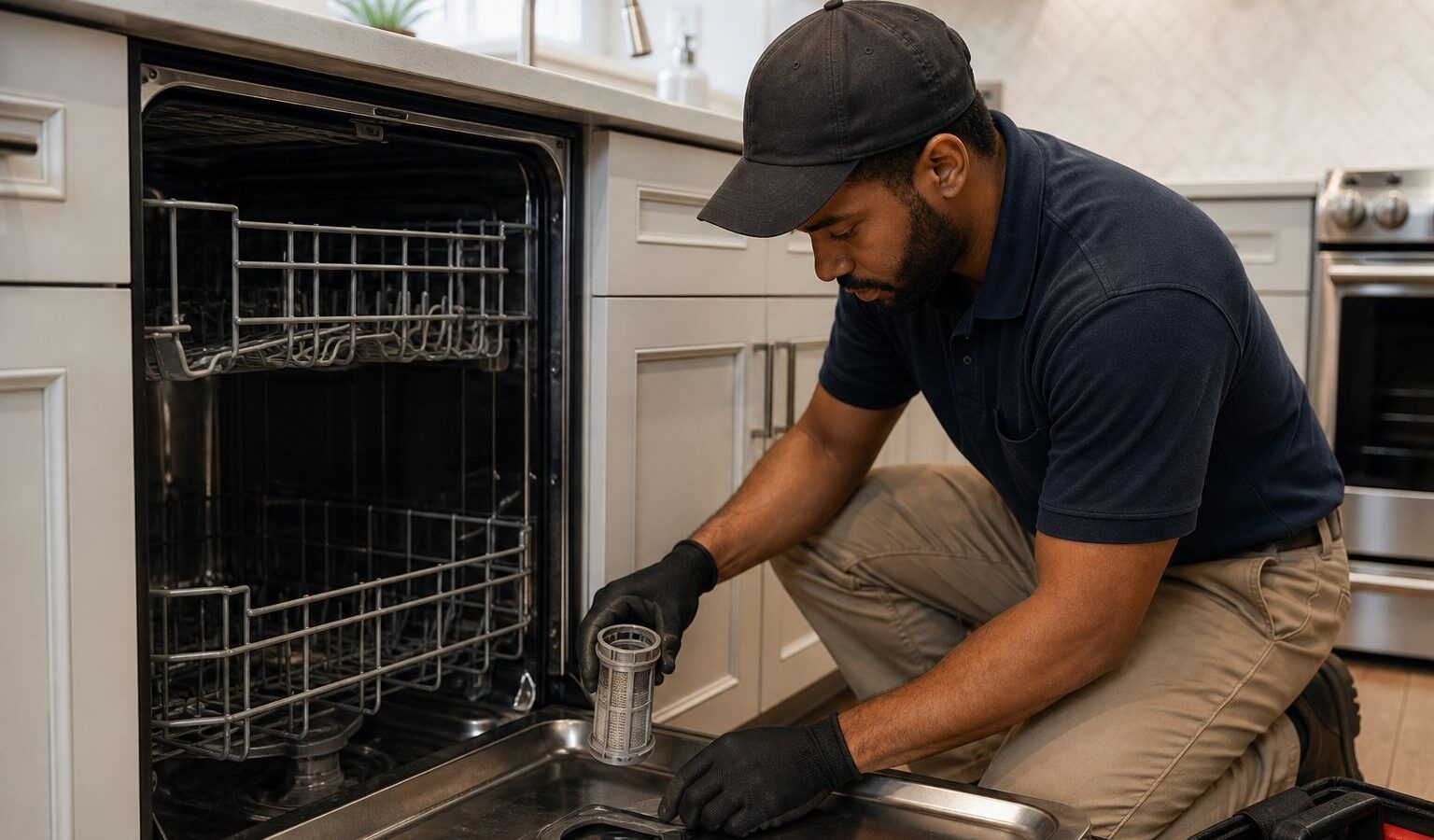
End the cycle if it is still running, give the tub time to settle, and use the manual to take out and rinse the filter you can reach. Keep the dishwasher in place and never force panels, fittings or controls. If a small change alters what you see, run one regular cycle before reaching a conclusion. Lift out visible debris, but do not reach down beneath the filter.
Sometimes a drainage complaint comes down to a kink in the drain hose you can see, or a disposer hookup made recently, rather than a failed pump. Also track when it happens: every cycle, only with certain loads or settings, or after the dishwasher has run a while. Knowing that is more useful than restarting it repeatedly.
| What you see | Probable cause | Safe check |
|---|---|---|
| Standing water at cycle end | Filter clogged with debris | Rinse out the filter |
| Slow emptying | Hose pinched | Inspect the part of the hose in view |
| Drain error displayed | Obstruction or pump problem | Record the code |
According to the owner manual for one Bosch dishwasher, E:61-03 (the not-draining message) and E:61-02 are not faults of the appliance itself. Check whether a disposal plug is still sealed, whether the hose has a kink, what condition the pump cover is in, and whether the high loop was left out. E:92-40 is a separate message: soiled or blocked filters.
That means a drain code does not automatically indicate a failed pump. A recently installed disposer or a hose that has been pushed back behind the machine can produce the same symptom. A technician will want to know what changed recently.
Look in the use-and-care manual for the controls, filter access and care intervals that apply to your model. Handle only the parts it labels as owner-serviceable, use the cleaners it suggests, and return each removable piece to the exact spot it was designed for.
Prior to starting the dishwasher again, clear obstructions and avoid overloading, then confirm that the water supply, airflow and door clearance are free. Resetting repeatedly is risky: an intermittent fault can stay hidden, and water, heat or pressure can end up in the wrong place.
The same manual says to clean the drain pump when water no longer drains, but it involves unplugging the machine, removing the racks and the filter, scooping out water and prying off the pump cover, and it warns that sharp debris such as glass may be present. For many owners this is beyond a comfortable check, so stop after the filter and visible hose.
Bosch US support says the filter needs regular cleaning to avoid overflow, and advises removing the lower rack and the spray arm, twisting the filter out and rinsing it with mild soap and a soft brush. Do that before any other step. After cleaning, run one short cycle and observe whether water remains.
Reasonable for owners
Better left to a technician
If the basic checks do not change what you see, stop at the owner-care boundary. Anything involving wiring inside the machine, heating circuits, pumps, motors, gas connections, refrigerant lines or control boards needs correct test equipment and a technician who can confirm the repair is safe.
Do not wait to book if the problem is worsening, the breaker trips, leaking occurs near electrical parts, there is a burnt or hot smell, a new grinding noise starts, or the dishwasher cannot get through a normal cycle. A machine showing a safety warning should not be kept in use.
If you decide to book, mention whether the dishwasher was working before a recent change, such as a new disposer, a move or a new hose. Include any code that appeared. These details let a technician arrive with the right idea of where to look, and they often matter more than a long description of what you tried.
Provide the model number, the precise symptom, the start date, the cycle settings chosen and what the safe checks showed. A picture of any code or a brief note about a sound can add detail, though a cover should never be removed for it.
A little water around the filter area may be normal, but standing water that stays points to a filter, hose or drain restriction. Rinse the filter and check the hose route.
It can. One Bosch manual lists a disposal plug that was not removed among the causes of a not-draining message, so check that with whoever installed it.
It is the way the drain hose is routed upward before it reaches the drain connection, and one Bosch manual lists a missing high loop among the reasons for drain trouble. Do not reroute the hose unless your manual shows how.
Watching closely will not repair a dishwasher, yet it is the best opening step. Take care of the simple conditions, hold on to any error information that shows up, and let a qualified appliance technician handle internal mechanical jobs as well as electrical, gas and sealed-system ones.
Dishwasher not draining, not cleaning, or showing an error code? We find the cause and get your Bosch dishwasher back to spotless cycles.
Bosch dishwasher diagnostics and repair — drainage, cleaning, leaks and error codes.
If a Bosch dishwasher leaves water behind and shows E24, E25, E61-02 or E61-03, the drain path needs checking from the pump outward.
Cancel the cycle if needed, allow the tub to settle, and follow the manual to remove and rinse the accessible filter.
Only if there is no burning smell, smoke, sparking, gas odor, water near electricity, or other safety warning. Otherwise stop and arrange service.
An error code is a starting point. The same code can describe a system condition without identifying the exact failed part.
A gas burner that clicks without lighting often deserves a careful cleaning-and-seating check before internal gas parts are suspected.
An oven does not hold one exact number every second. It cycles around the setpoint, so a single thermometer snapshot can make a normal…
Share a few details and we’ll confirm an appointment. Prefer to talk? Call us and we’ll help right away.
Use the secure scheduler below to request your appointment.