An oven does not hold one exact number every second. It cycles around the setpoint, so a single thermometer snapshot can make a normal oven look inaccurate.
An oven that reads high or low is often cycling normally, so judge it over a full heating cycle rather than one thermometer reading. If the same offset shows up repeatedly at one setpoint, the settings menu on many Bosch models has a temperature offset you can use, and a large or mode-specific difference is the point to book a diagnosis.
An oven does not hold one exact number every second. It cycles around the setpoint, so a single thermometer snapshot can make a normal oven look inaccurate.
A useful Bosch repair guide should narrow the problem before it narrows the part. Start with what you can observe from the outside: temperature, water level, sound, cycle stage, control response, loading, airflow, or the exact error shown on the display. Those details are more reliable than a guess made from one symptom.
The manual for one Bosch 800 Series built-in oven says that in Bake mode both the upper and lower elements cycle on and off to maintain the temperature. So the actual temperature swings around the setpoint, and a thermometer placed in the cavity will show the swing. The same manual says the oven is calibrated to give accurate results.
It also notes that the lower bake element is hidden under the oven bottom, which means preheat behavior can differ from an older oven with an exposed element. If you are comparing a new oven with your memory of an old one, that difference alone can feel like a temperature problem.
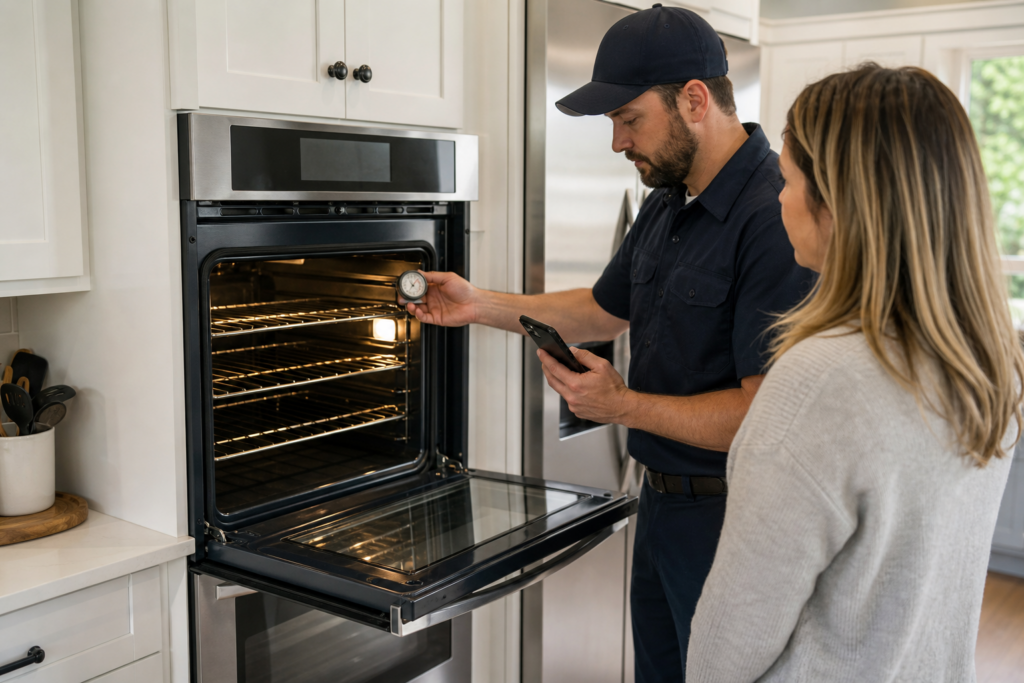
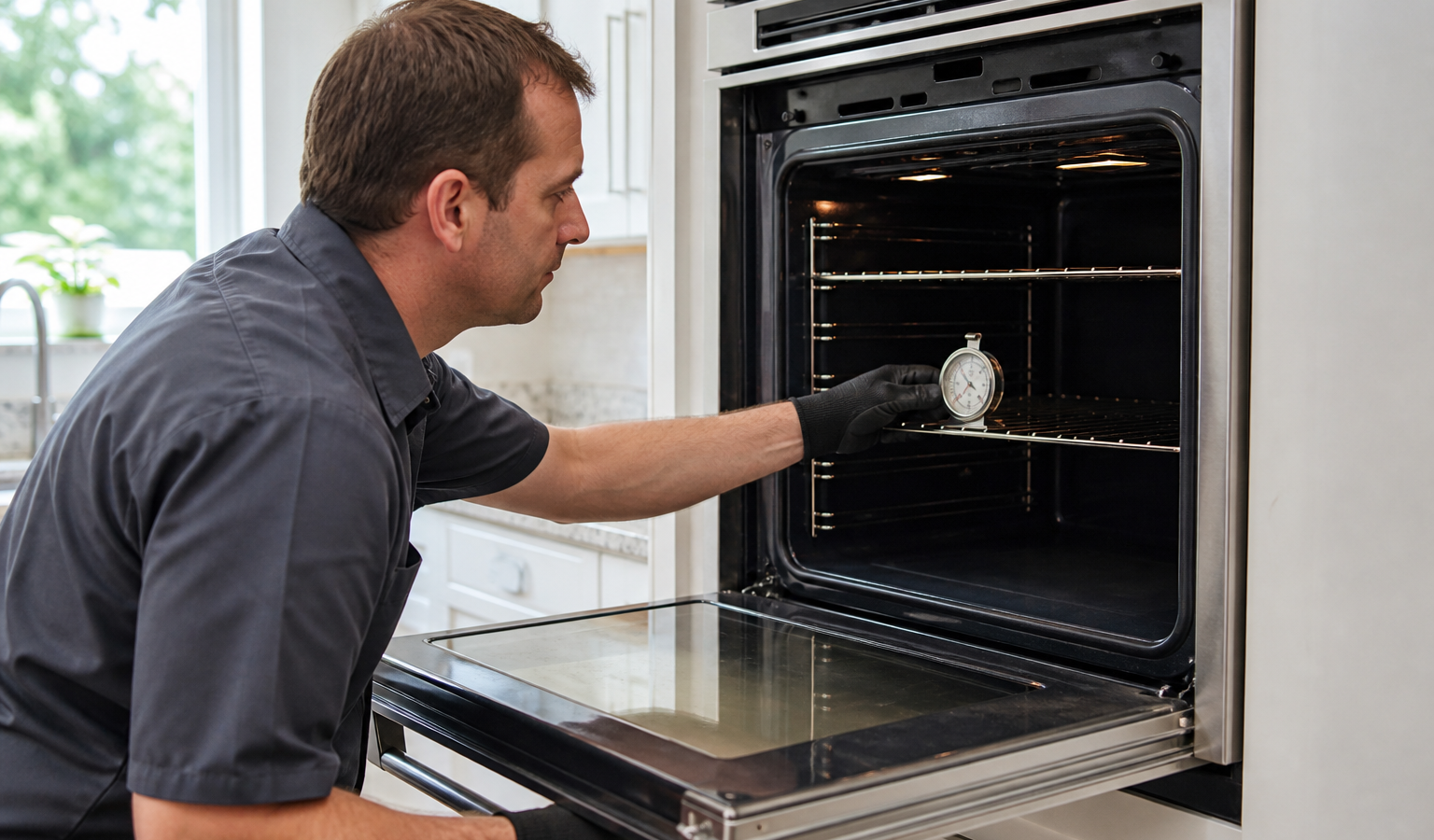
Use a reliable thermometer and watch the pattern across a complete preheat and heating cycle. A basic oven thermometer left on the middle rack gives a steadier picture than the oven display alone.
Keep the door closed and use a consistent rack position during comparison tests.
Record whether the difference happens in bake, convection or every mode. Compare convection with regular bake, because the fan changes how heat reaches the thermometer.
Make one change at a time. If you reset settings, clean several components, and change the load all at once, you lose the information about which condition mattered.
A large repeatable offset or mode-specific error can involve calibration, sensing, heating or controls and should be diagnosed from data rather than one reading.
Door seal condition, the rack you use and dark or shiny bakeware can all change results without any fault in the oven. Rule those out first, and then repeat the test at the same setpoint so one variable changes at a time.
When a technician is called, a record of setpoint, thermometer reading and mode across two or three heating cycles shows whether the error is steady, drifting or tied to one mode. That is more useful than a single reading.
A technician can then test the relevant electrical, mechanical, water, gas, or refrigeration system instead of starting with a generic parts guess.
| What you observe | What it can point to | What you can check |
|---|---|---|
| Reading swings up and down but averages near the setpoint | Normal element cycling | Watch a full cycle, not a single moment |
| Food is always too brown or too light | The oven runs slightly off for your cooking | Look for the temperature offset in the manual and settings |
| Only convection is off | The fan or mode-specific heating | Compare the same temperature in bake |
| Reading is far from setpoint every time | Sensing, heating or control issue | Repeat the test and book diagnosis |
| Different readings at different rack heights | Heat distribution rather than control error | Keep one rack position for the test |
The 800 Series manual describes a Temperature Offset setting that raises or lowers the actual oven temperature, and says it is useful if food is consistently too brown or too light. On that model it adjusts up to 35 degrees F either way in 1 degree steps, applies to Bake, Convection Bake, Roast, Convection Roast and Convection Multi-Rack, and has to be set with the oven off. A Bosch gas range manual describes a similar option in its function menu with 5 degree steps. Ranges and steps vary by model, so follow your own manual.
The offset is for fine-tuning a working oven, not for hiding a fault. If you need a very large correction, or the correction does not hold, that is information a technician can use.
The same manual says Convection Bake and Convection Multi-Rack need a temperature 25 degrees F lower, and that Auto Convection Conversion does this automatically when switched on. It ships turned off. If you are cooking with convection and the food runs dark, check whether the conversion is on before concluding that the oven is too hot.
Write down the full model number and a one-sentence description of what changed. If the issue comes and goes, include the condition that makes it appear. Do not move a built-in appliance, remove electrical panels, or disconnect gas components unless the service team specifically instructs you to do so.
Yes, within a cycle the temperature rises and falls as the elements switch on and off. Look at the pattern across a full cycle, not at a single reading.
Many models include a documented temperature offset in the settings. Use the range and steps in your manual and change it once at a time, so you can see its effect on the food.
The fan circulates the heat, so food can cook faster and brown more. Several Bosch manuals call for a lower recipe temperature in convection modes, either manually or with automatic conversion.
An error code is a starting point. The same code can describe a system condition without identifying the exact failed part.
A gas burner that clicks without lighting often deserves a careful cleaning-and-seating check before internal gas parts are suspected.
Preheat complaints are easiest to evaluate when you compare the same mode, setpoint and starting condition.
Share a few details and we’ll confirm an appointment. Prefer to talk? Call us and we’ll help right away.
Use the secure scheduler below to request your appointment.