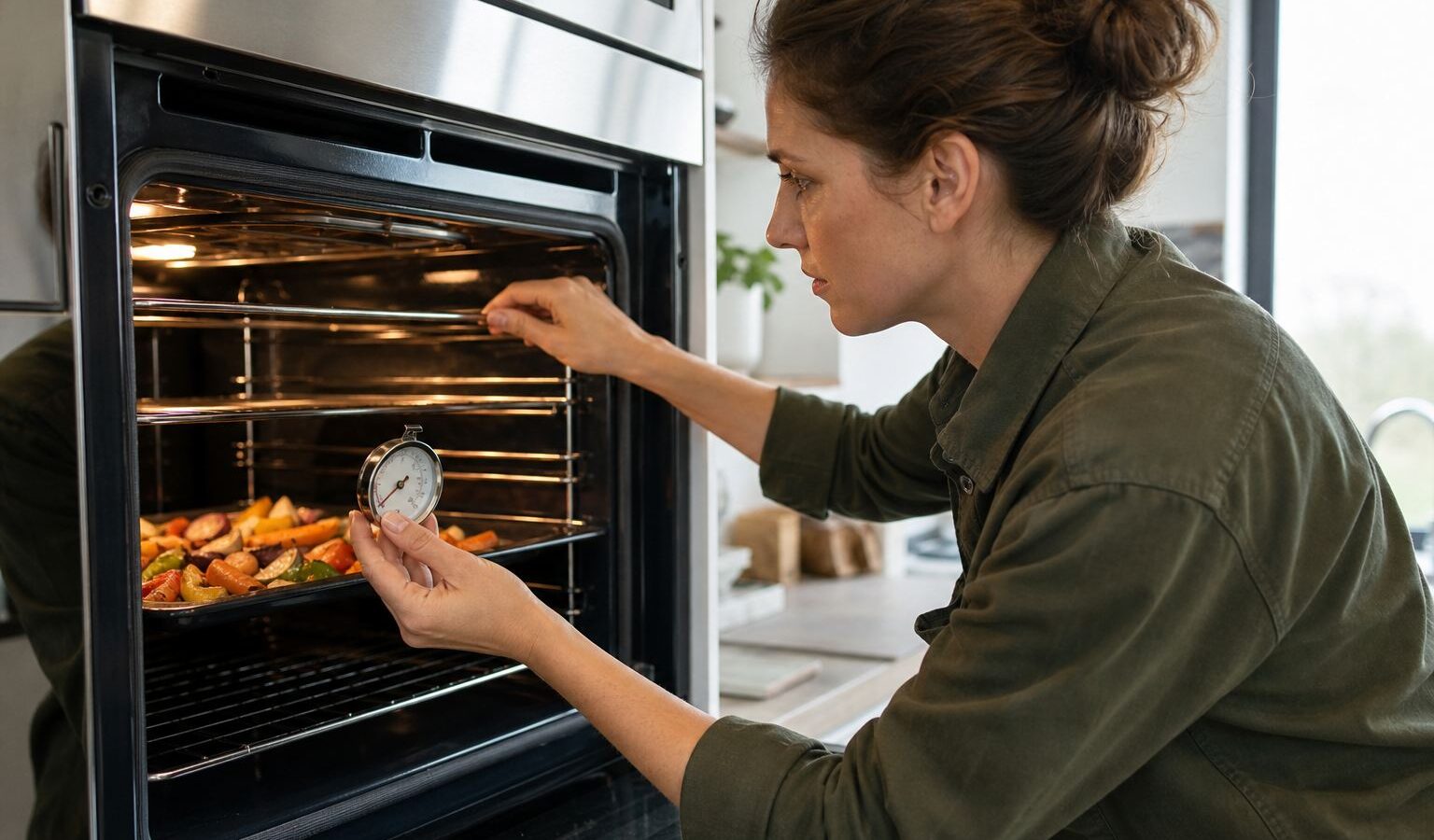
Hot spots can be about placement and mode, though persistent temperature errors need testing.
An oven that cooks unevenly is most often reacting to rack position, pan size, preheating or mode before it points to a failed part. Check those first, and consider the Temperature Offset setting in your manual if food keeps coming out too dark or too pale.
When an oven bakes unevenly, that symptom by itself cannot tell you which part has failed. Begin with safe observations you can repeat, since those notes are also what a repair visit would need, and a disrupted kitchen routine is no reason to hurry.
Think of routine care as a separate category from anything needing tests or a teardown. Overriding a door lock, defeating a safety switch or ignoring an error message so the oven keeps running is off the table. Notes jotted down at this stage make the final diagnosis quicker and more reliable.
Let the oven preheat all the way, put the food on a middle rack when the recipe permits, and keep sheet pans from being so large or so crowded that they choke the airflow. Run the check with the oven installed in its usual position and never pry at panels, fittings or controls. When a small adjustment changes the result, bake one ordinary batch before deciding anything. A fan that switches on and off in certain modes is normal, so a shifting fan noise on its own is not a fault.
If only one recipe turns out badly, technique is the likelier explanation; a side that stays underdone every single time is the case that may justify a temperature diagnosis. Watch for the pattern instead. Does it happen on every bake, only with a certain pan or mode, or only after the oven has been on for a while? Knowing that tells you more than switching the oven off and on repeatedly.
| Result | Likely cause | Safe check |
|---|---|---|
| Patchy browning | Airflow blocked by a crowded rack | Bake one tray in the center |
| Bakes slowly | Oven not yet at temperature | Wait for the ready signal |
| Big gap from the set temperature | Sensor or heating element | Book a test |
The use-and-care manual for one Bosch 800 Series oven says Convection Bake works like Bake, using the upper and lower elements, but the fan circulates the heat. It lists a slight decrease in cook time and higher volume as benefits. Convection Multi-Rack adds a third element behind the back wall plus the fan and suits cooking on two or three racks at once.
Rack positions are numbered 1 to 6 from the bottom, and that manual suggests position 3 for most single-rack baking, position 2 for small roasts, pies and breads, and position 1 for large roasts. For several pans it says to leave at least one to one and a half inches of air space around each pan and stagger them rather than stacking one directly above another.
Look up controls, access points and upkeep schedules for your exact model in its use-and-care booklet. Limit cleaning to parts the booklet describes as yours to handle, stick to the cleaners it names, and put each removable piece back precisely the way it was designed to sit.
Before baking again, take away whatever obstructs the oven, scale back a load that is unusually heavy, and see that airflow, the water supply and door clearance are unrestricted. Constant resetting works against you, because a fault that appears only occasionally can slip past unnoticed, and heat, water or pressure may be left where it should not be.
The same manual says Convection Bake and Convection Multi-Rack need a temperature 25 degrees F lower, and that Auto Convection Conversion does this automatically, although the factory default is off. If it is not active, you lower the recipe temperature yourself. A recipe that browns too quickly on a convection mode may have simply not been converted.
The manual also describes a Temperature Offset setting, which raises or lowers the actual oven temperature and is useful if food is consistently too brown or too light. On that model it ranges plus or minus 35 degrees F in one-degree steps, with 0 as the default, and the oven must be off to change it. Another Bosch range manual lists a smaller range, so use your own.
The manual also explains that preheat times are longer for higher targets and can differ from an older oven with an exposed element. Wait for the ready signal before loading food.
Safe to try
Leave to a technician
If the basic checks leave the symptom untouched, owner-level work ends there. Gas connections, refrigerant lines, motors, pumps, heating circuits, internal wiring and control boards demand dedicated testing instruments, and the repair has to be carried out safely by a technician who knows how.
Book service soon if results are slipping, the breaker trips, water leaks near electrical parts, there is a hot or burnt smell, a new grinding sound appears, or a normal cycle will not finish. Stop using any appliance that is showing a safety warning.
Give the technician the model number, the precise symptom, when it started, which settings you used, and what the checks above turned up. A photo of a code or a brief description of a sound helps too, but a cover must never come off just to get one.
Probably not. A single recipe may need a different rack or pan. The manual suggests the offset for food that is consistently too brown or too light across recipes.
The manual for one Bosch oven says convection bake and multi-rack modes need 25 degrees F lower, done automatically if Auto Convection Conversion is on. Check your own model.
Airflow, pan size and rack position all affect it. Try a single centered tray first, and if one side keeps undercooking, book a temperature check.
Observation is no replacement for a repair, but it is where to start. Work through the simple conditions, hold onto any error information that might help, and send anything involving electrics, gas, a sealed system or internal mechanisms to a qualified appliance technician.
Preheat fully, use a center rack where the recipe allows, and avoid oversized pans or crowded trays that block airflow.
Only if there is no burning smell, smoke, sparking, gas odor, water near electricity, or other safety warning. Otherwise stop and arrange service.
A gas flame that suddenly changes shape can be caused by burner cleanliness and cap position, but color and stability can also point to…
The location and timing of a washer leak usually narrow the possibilities faster than the size of the puddle.
A dishwasher leak should be described by when and where it appears. Water at the front during filling is different from water under the…
Share a few details and we’ll confirm an appointment. Prefer to talk? Call us and we’ll help right away.
Use the secure scheduler below to request your appointment.