Long drying times often trace back to restricted airflow. Start with these safe checks.
A Bosch dryer that takes too long is usually struggling with moisture leaving the drum or with how the sensors read the load. Start with the lint filter, the load size and the dryness setting, then check the area around the front air inlet before suspecting a part.
If a dryer needs far longer than it should, that symptom alone does not point to a broken part. Start with safe, repeatable observations, which will also be useful should you later book a repair visit, and do not let the disruption to laundry day push you into shortcuts.
Everyday upkeep is one thing and work that needs testing or taking the dryer apart is another. Do not get around a lock, a safety switch or an error message to keep the machine running. Notes written down now help the diagnosis go quicker and land closer to the mark.
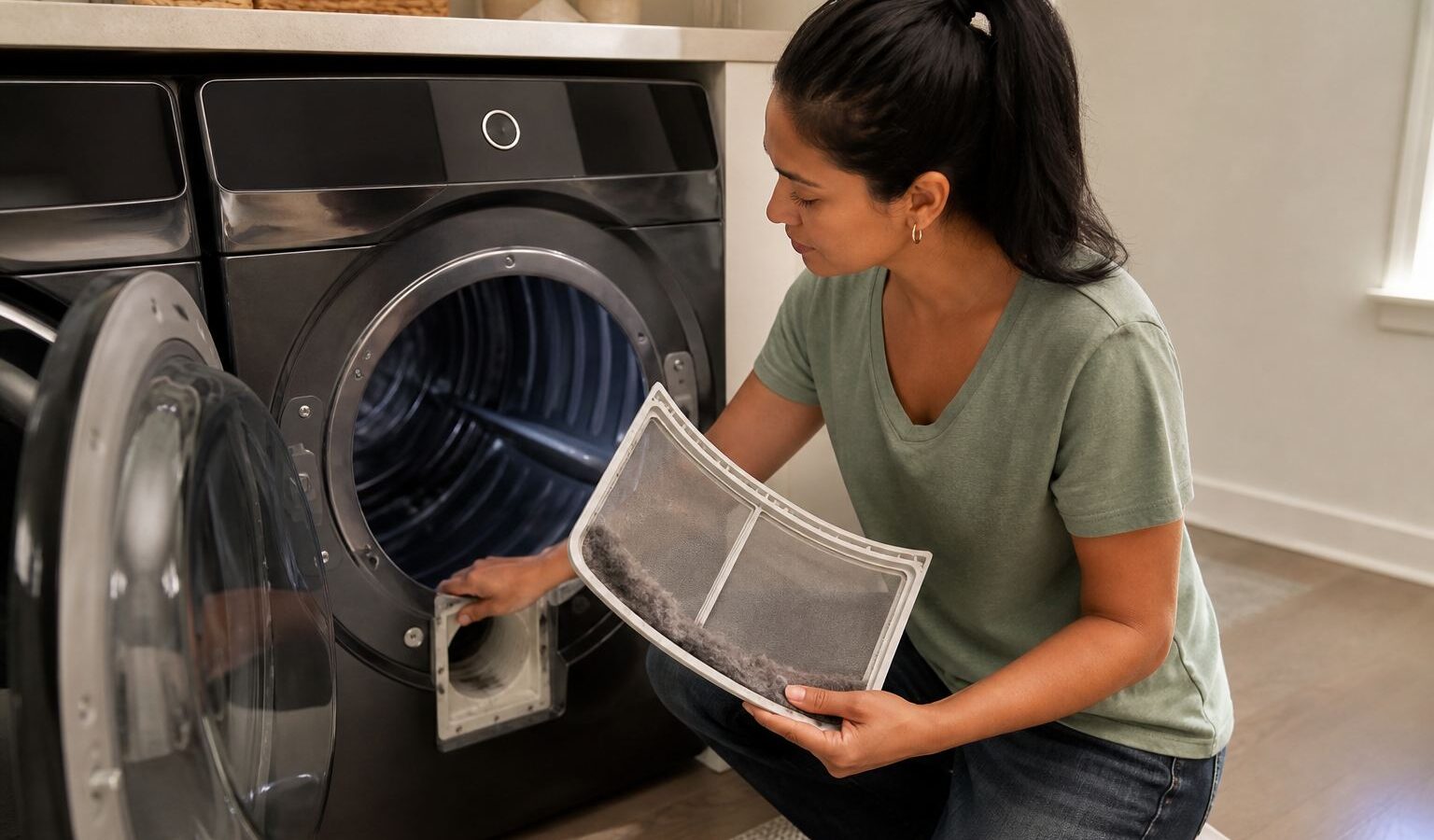
Empty the lint screen, take some laundry out if the drum is stuffed, and look over the visible vent hose for crushing or tight kinks. Do the check with the dryer left in its normal spot, forcing no panels, fittings or controls. Should a small change alter the outcome, dry one regular load before judging. Laundry that just came out of a very high spin may finish sooner, so keep that in mind when comparing runs.
Cycles that run long, laundry that comes out hotter than usual and a weak flap at the outside vent all hint that damp air is not escaping well. Notice the pattern: every load, one kind of load or setting, or only once the dryer has been running a while. That detail says more than starting it over and over.
| Symptom | Likely cause | Safe check |
|---|---|---|
| Needs a second cycle | Lint blocking airflow | Clean the screen |
| Clothes come out hot | Restricted vent | Look over the visible hose |
| Produces no heat | Internal component | Stop and book service |
According to the manual for one Bosch condensation dryer, sensors govern the automatic programs, so run time follows the moisture they detect in the laundry together with the dryness level you pick, Cotton Dry being one example. Choosing a higher dryness or loading something damp and bulky will naturally take longer than a light load.
That manual also mentions a stainless-steel moisture sensor made of two bars beside the lint filter. A limescale or detergent film on it can impair drying, and the manual’s fix is a cloth with a little white vinegar once a month. Bosch US support adds that the dryer should be unplugged before you clean the interior, the sensor or the condenser. When reaching it on your model seems uncertain, leave it for the visit.
Controls, filter access and maintenance intervals differ by model, so check the booklet that came with the dryer. Clean just the parts it presents as owner-serviceable, use only the products it recommends, and seat every removable part back in its intended position.
Before you run the dryer again, clear anything in the way, shrink an unusually heavy load, and be sure airflow and door clearance are not being squeezed. Pressing reset again and again is best avoided, because it can hide an on-and-off fault and may leave water, heat or pressure in the wrong place.
That manual’s troubleshooting lists a few causes for a drying time that is too long: a dirty lint filter, a dirty heat exchanger, an obstructed air inlet on the front of the dryer, or an ambient temperature above 95 degrees F. It also notes that low temperatures may prolong drying. Each of these changes how well air moves or how well moisture is carried out.
A dirty filter extends drying time and increases energy use, so cleaning it is the first move. Heat exchanger cleaning, described in the manual as about once a month under normal conditions, follows a set of steps that include cooling the dryer and rinsing the part with warm water only. If your dryer has an exterior vent instead, apply the visible vent checks above.
Safe to try
Leave to a technician
Once the basic checks leave the symptom as it was, go no further than owner-level work. Control boards, motors, pumps, heating circuits, gas and refrigerant connections and internal wiring all need the right test equipment, and a technician has to verify the repair is safe.
Get service lined up quickly when performance keeps declining, a breaker trips, liquid leaks near electrical parts, a hot or burning smell shows up, a fresh grinding noise starts, or the dryer cannot finish a normal cycle. An appliance that displays a safety warning should not be kept running.
Tell the technician the model number, exactly what the dryer does, when that began, the settings you used and how the safe checks above turned out. Photographing a displayed code or describing a sound in a few words is fine, though no cover should ever be removed to collect either.
Yes, on sensor-controlled programs the time follows the measured moisture and the level you pick. Compare the same load at a lower dryness setting before deciding anything is wrong.
On an automatic program the sensors decide when the laundry reaches the chosen level. A film on the moisture sensor can mislead that reading, so the monthly wipe in the manual is worth doing.
Warm laundry after a cycle is expected, but very hot clothes together with repeated long cycles point toward restricted airflow. Describe both details to the technician.
Close observation will not take the place of a repair, but it is the strongest first move. Work through the simple conditions, keep any error details that could help, and hand electrical, gas, sealed-system and internal mechanical work over to a qualified appliance technician.
Clean the lint screen, reduce an overloaded drum, and inspect the visible vent hose for crushing or sharp kinks.
Only if there is no burning smell, smoke, sparking, gas odor, water near electricity, or other safety warning. Otherwise stop and arrange service.
A gas flame that suddenly changes shape can be caused by burner cleanliness and cap position, but color and stability can also point to…
The location and timing of a washer leak usually narrow the possibilities faster than the size of the puddle.
A dishwasher leak should be described by when and where it appears. Water at the front during filling is different from water under the…
Share a few details and we’ll confirm an appointment. Prefer to talk? Call us and we’ll help right away.
Use the secure scheduler below to request your appointment.