Recurring frost is usually a moisture story: humid air is getting into a place that should stay cold and dry, or defrost water is not leaving correctly.
Recurring freezer frost usually means moist air is reaching a cold surface or the freezer is losing cold air through the door, so check the door seal, closing and packages blocking airflow first. Heavy frost that returns after you have cleared those, or frost touching the fan, calls for diagnosis of the defrost and airflow parts.
Recurring frost is usually a moisture story: humid air is getting into a place that should stay cold and dry, or defrost water is not leaving correctly.
A useful Bosch repair guide should narrow the problem before it narrows the part. Start with what you can observe from the outside: temperature, water level, sound, cycle stage, control response, loading, airflow, or the exact error shown on the display. Those details are more reliable than a guess made from one symptom.
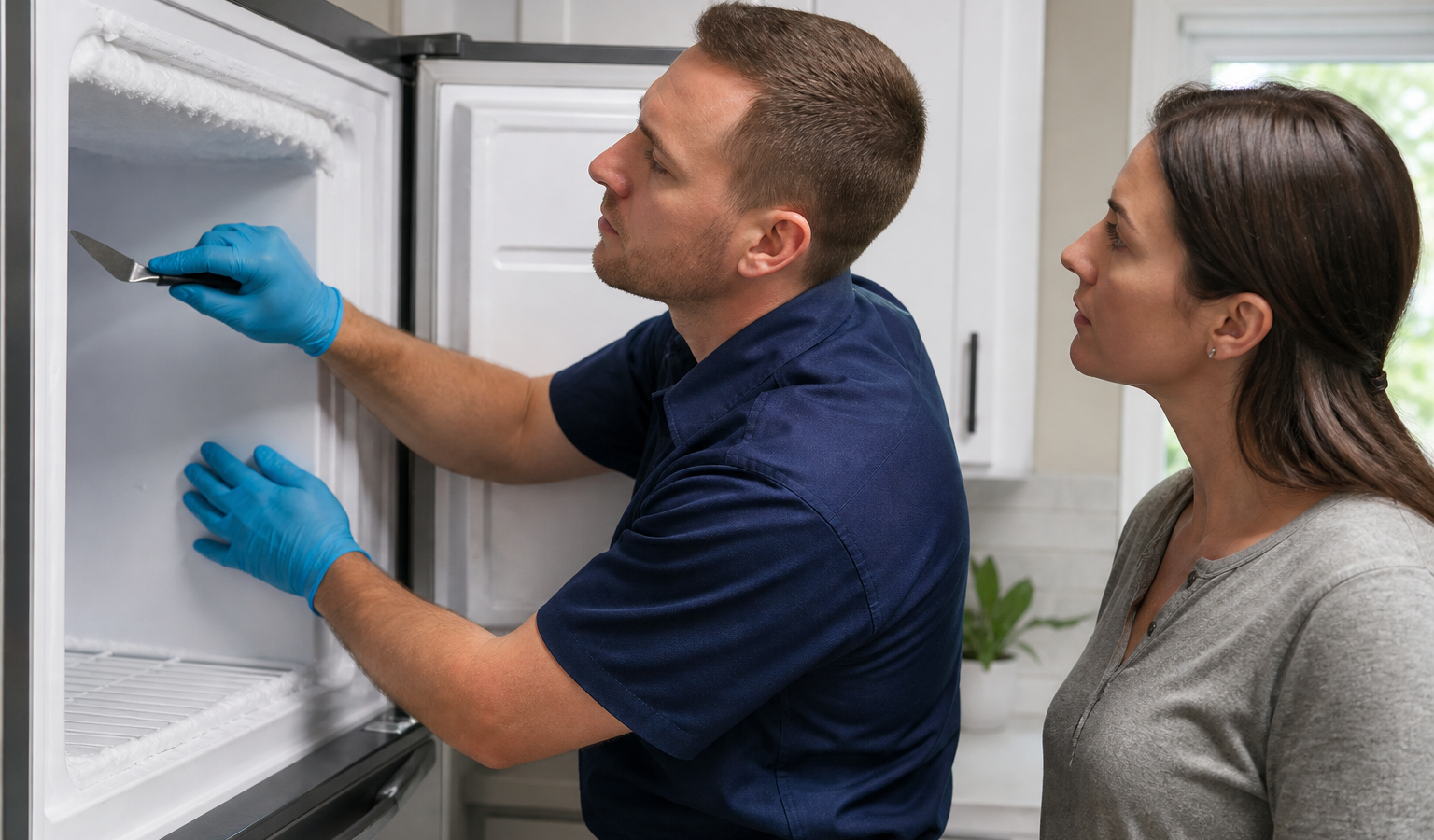
Frost builds when warm, humid air meets very cold surfaces. Every time the door opens, or whenever the gasket does not close fully, a little humid air enters and freezes onto the coldest parts. A small amount of frost is normal; frost that keeps returning in thick layers suggests moisture is getting in faster than the appliance can clear it.
That is why door closing and gasket contact come first. A door that sits a little open, even from a bag or a tray, lets in humid air for as long as it stays that way.
Check that the freezer door closes freely and the gasket contacts the frame all the way around. Wipe the gasket where frost meets the frame, because dirt there can prevent a full seal.
Look for packages that hold the door slightly open or block internal air movement. Leave a little space around packages so cold air can circulate inside.
Note whether frost is light and widespread, concentrated around the door, or forming as a solid sheet on one panel.
Overfilled shelves can block the air vents inside the compartment, and blocked air movement leaves some areas colder and others warmer, which changes where frost forms.
Make one change at a time. If you reset settings, clean several components, and change the load all at once, you lose the information about which condition mattered.
Heavy recurring ice, fan contact with ice or warming temperatures can involve defrost, drainage, sensing or airflow components that require internal testing.
A technician can check whether the defrost cycle and drain path are working and whether the fan is moving air as it should. Describe where the frost forms and how fast it returns, because a sheet on one panel and light frost everywhere point in different directions.
While you wait, keep the door closed as much as possible and move food away from air vents. If food begins to soften, move it to a working freezer rather than relying on a freezer that is not holding temperature.
A technician can then test the relevant electrical, mechanical, water, gas, or refrigeration system instead of starting with a generic parts guess.
| What you notice | What it can point to | What you can check |
|---|---|---|
| Frost near the door edge | Humid air entering at the seal | Check that the door closes and the gasket is clean |
| Light frost across the compartment | Frequent door openings or humid air | Reduce time the door is open and check packages |
| Thick sheet of ice on one panel | Drainage or defrost problem | Note where it forms and book diagnosis |
| Frost after a power interruption | Temperature settings or door ajar | Check the temperature settings and the door |
| Ice touching the fan area | Airflow or defrost | Stop and book service; do not chip it |
The manual for one Bosch refrigerator lists factory settings of 39 F for the fridge and 0 F for the freezer, and the Bosch refrigerator FAQ recommends 0 F for the freezer. It says to allow several hours before loading food after changing a setting. Another manual says a door alarm sounds after the door has been open for more than a minute, so a sound that repeats may point to a door that is not closing.
After a power failure, the manual for one model says the fresh-food temperature must be readjusted, so confirm your settings after an outage.
Do not chip ice off with tools or use heat to speed up a thaw, because that can damage the liner and the parts behind it. Check your manual for any thaw guidance for your model, and let ice melt on its own rather than forcing it.
Write down the full model number and a one-sentence description of what changed. If the issue comes and goes, include the condition that makes it appear. Do not move a built-in appliance, remove electrical panels, or disconnect gas components unless the service team specifically instructs you to do so.
Frost forms when humid air reaches cold surfaces. A door that does not seal, items blocking it open or frequent openings let in that air, while a drainage or defrost problem can leave ice behind.
A thin layer is normal because every door opening admits some moist air. Thick or growing frost is worth investigating.
If the manual describes a thaw for your model, follow it. Do not chip ice or use heat sources near the liner, and book service if frost returns quickly.
A gas flame that suddenly changes shape can be caused by burner cleanliness and cap position, but color and stability can also point to…
The location and timing of a washer leak usually narrow the possibilities faster than the size of the puddle.
A dishwasher leak should be described by when and where it appears. Water at the front during filling is different from water under the…
Share a few details and we’ll confirm an appointment. Prefer to talk? Call us and we’ll help right away.
Use the secure scheduler below to request your appointment.