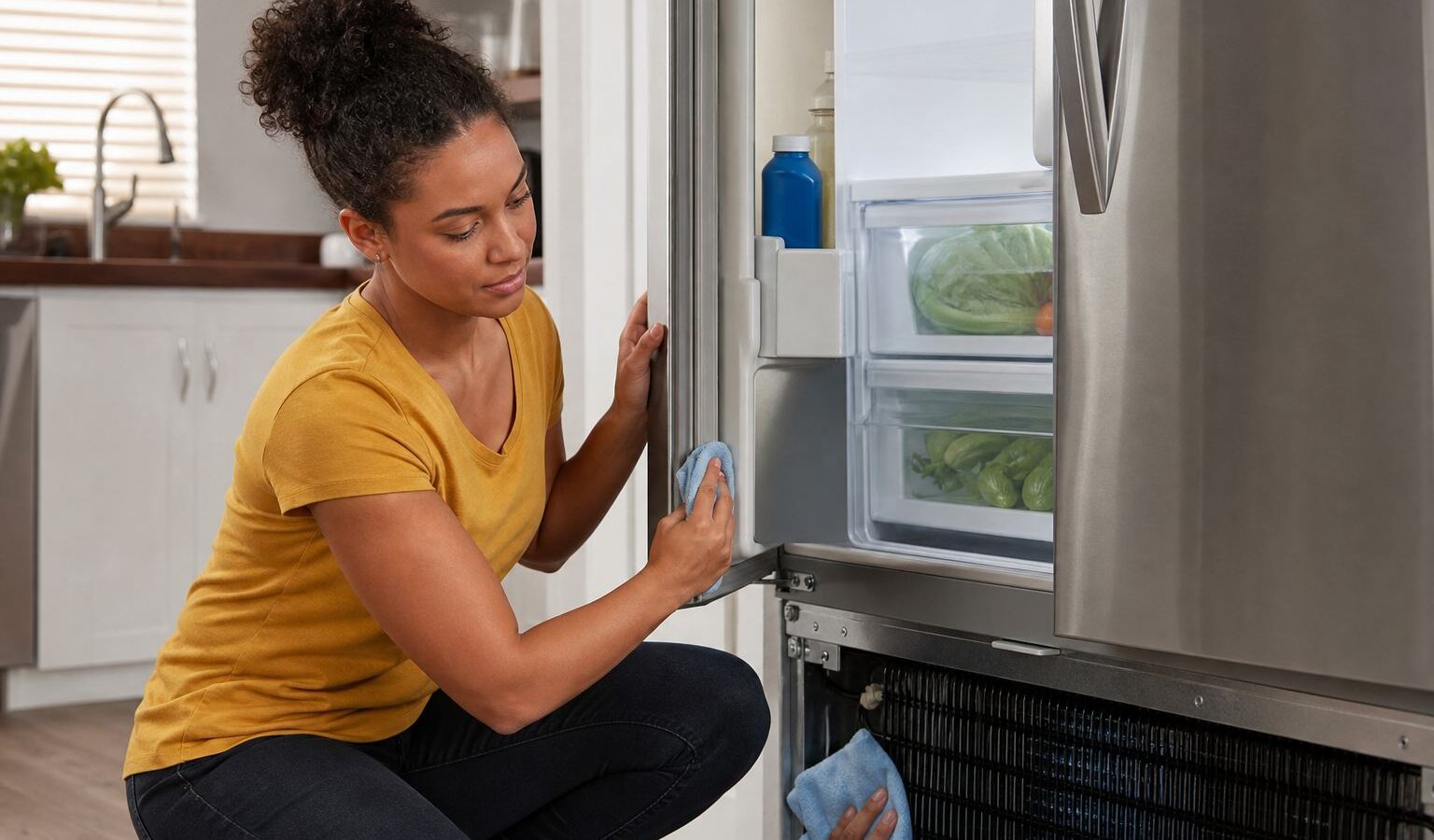
Clear airflow and clean door seals help a refrigerator run efficiently.
Refrigerator care mostly means keeping the door seals clean, keeping air vents clear and leaving room around the cabinet. If the compartments are warm, check the temperature setting and the door closure first, and call for service when the settings are correct and the temperature still will not hold.
Routine refrigerator upkeep comes with the same caution as any symptom: nothing here singles out a failed part. Start with observations that are safe and repeatable, which will serve you if a repair visit comes later, and keep calm about the disruption to your kitchen.
Care you can do yourself is kept apart from work needing tests or disassembly. Do not sidestep a door lock, skip past a safety switch or dismiss an error message in order to keep the unit going. Some notes taken now will help the eventual diagnosis move faster and come out more accurate.
Wipe the door gaskets, take food away from the interior vents, and keep dust off the part of the condenser area you can reach without tools. Carry out the check with the refrigerator where it normally sits, and do not force panels, fittings or controls. If a simple adjustment changes the result, let the unit run through one normal period before concluding anything.
Warm room air creeping in past a grimy seal makes a refrigerator labor harder, and so does restricted ventilation around the cabinet. Check whether the trouble recurs constantly, only with a given load or setting, or just after long running; knowing that is worth more than power-cycling the unit. A handy seal test: with the door shut, does the gasket press flat against the cabinet all the way around?
| Task | How often | Safe check |
|---|---|---|
| Wipe the seals | Once a month | Look for crumbs |
| Clear the vents | Every week | Keep air gaps open |
| Dust the reachable area | Each season | Use a gentle brush |
The manual for one Bosch refrigerator lists factory settings of 39 degrees F for the fridge and 0 degrees F for the freezer, with the fridge adjustable from 34 to 44 degrees and the freezer from 9 degrees to minus 8. It says to allow several hours before loading food after a change. Because of that delay, a setting adjusted a few minutes ago cannot tell you whether the change worked.
A seal that does not close well lets warm air in, so the compressor system runs longer to keep up. Crumbs, sticky residue and a door held open by a shelf item are the usual things you can see and fix. A slightly open door will not cool properly whatever the settings say.
The controls, filter access and care intervals for your model are covered in its use-and-care manual, so refer to it. Only clean the parts it names as owner-serviceable, use the cleaners it advises, and return each removable piece to the spot it was designed for.
Prior to testing again, get rid of obstructions, ease off a load that is unusually full, and confirm that airflow, water supply and door clearance are not restricted. Skip repeated resets: an intermittent fault can hide behind them, and water, heat or pressure might be left in a spot where it does not belong. Note where any water pools on the floor, since the leak page from Bosch US names two causes to rule out first, a dirty contact area on the door seal and excess or old detergent coming from the drawer.
Some modes change the temperature on purpose. The manual for one Bosch refrigerator describes Super Cool, which sets the fridge to 34 degrees F and ends automatically, and Eco Mode, which sets 44 degrees F and 5 degrees F for vacations. A compartment that feels different from usual may be in one of these modes, so look at the display before suspecting a fault.
The manual for a dispenser model also says the door alarm sounds after the door has been open for more than a minute, and repeats every 60 seconds for five minutes. A temperature alarm appears when the interior gets too warm. After a power failure, the manual says the fresh-food temperature must be readjusted. Your own manual describes what your model does.
Safe to try
Leave to a technician
Should the basic checks leave the symptom as is, stop where owner-level work ends. Control boards, motors, pumps, heating circuits, gas connections, refrigerant lines and wiring inside the cabinet require appropriate test equipment and a technician who can confirm that the repair is safe.
Get service arranged soon if performance is worsening, a breaker trips, liquid appears near electrical parts, the unit smells hot or burnt, a new grinding sound starts, or it cannot complete a regular cycle. An appliance showing a safety warning should not be kept in use.
Give the technician the model number, the exact symptom, the date it began, the settings in use and what the safe checks above revealed. A picture of a code or a short description of the sound can add useful detail, but no cover should come off to obtain it.
The table above suggests monthly as a routine. Use a soft cloth and mild cleaning, and check for crumbs in the folds where the seal meets the cabinet.
Only the accessible dust area, with a gentle brush as described. Covers around the compressor and any sealed refrigerant parts are not owner territory.
Controls may need to be readjusted, and the cabinet needs several hours to settle once power returns. If the compartments still do not hold the set temperature after that, note what happened for the technician.
Close attention is not a repair, though it makes the best first step. Take care of the simple conditions, hold on to any helpful error information, and pass electrical, gas, sealed-system and internal mechanical work on to a qualified appliance technician.
Wipe the door gaskets, clear food from interior vents, and keep the accessible condenser area free of loose dust.
Only if there is no burning smell, smoke, sparking, gas odor, water near electricity, or other safety warning. Otherwise stop and arrange service.
Clean venting improves drying performance and is an important home-safety habit.
Simple gasket, drawer, and drum care helps prevent musty odors in front-load washers.
A clean filter supports good drainage and cleaning. Here is a safe routine.
Share a few details and we’ll confirm an appointment. Prefer to talk? Call us and we’ll help right away.
Use the secure scheduler below to request your appointment.