A clean filter supports good drainage and cleaning. Here is a safe routine.
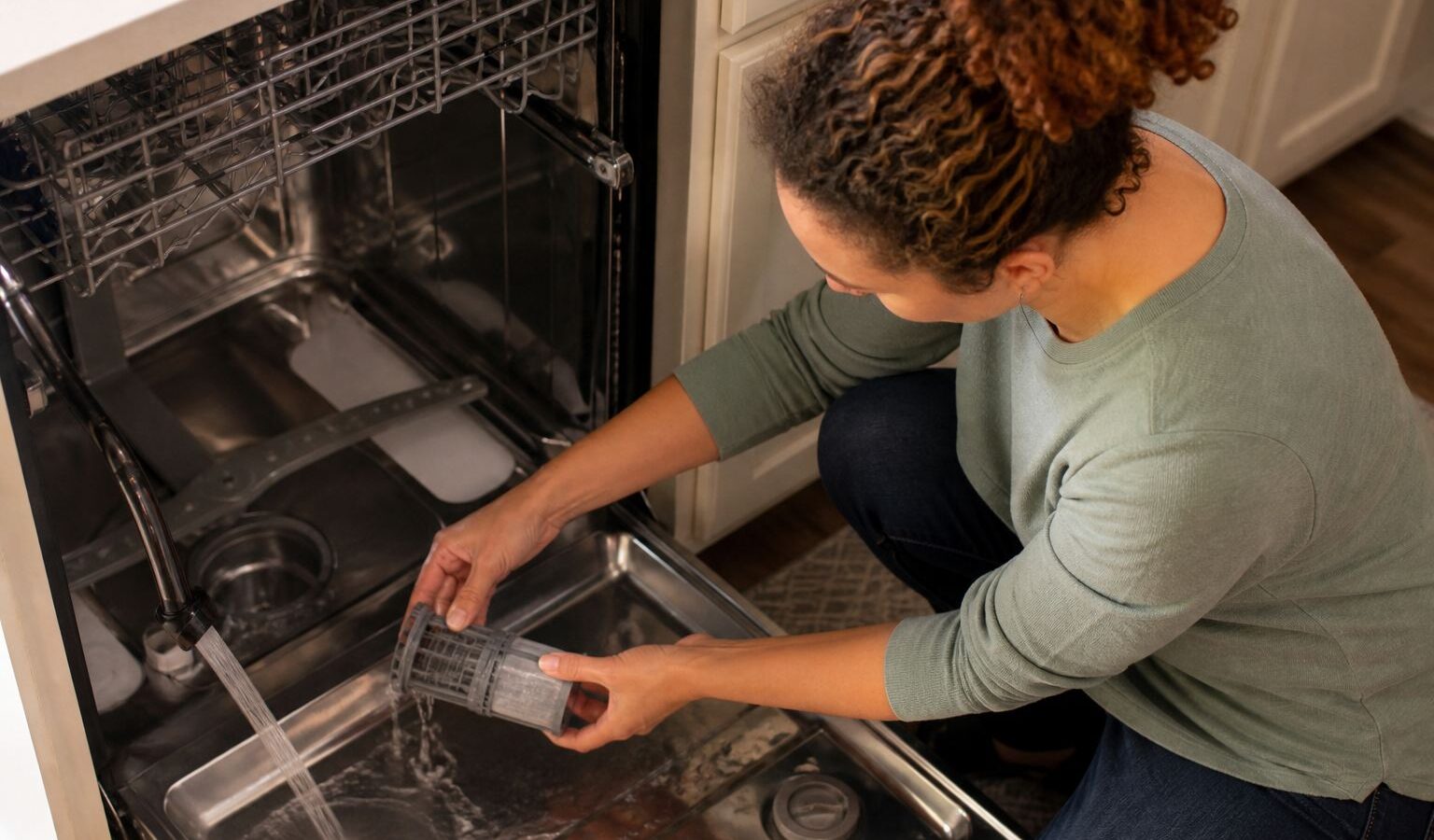
To clean a Bosch dishwasher filter, wait until the machine is off, take out the lower rack, twist the filter out as the manual shows, rinse it under running water with a soft brush, and refit it until it sits securely. Never run the dishwasher without it, and stop if you would need to reach into the pump area.
Whether the dishwasher filter is gunked up or just due for a rinse, the symptom alone does not identify a failed part. Begin with safe, repeatable observations that will also serve you if a repair visit follows, and do not let a hectic kitchen push you to skip steps.
There is routine care, and there is work needing tests or disassembly; the two should stay separate. Never get around a lock, a safety switch or an error message to keep the machine going. Writing a few notes down now gives the later diagnosis a quicker, more accurate start.
Make sure the dishwasher is switched off and cool, then follow the manual to find the filter, turn it and lift it out exactly as shown. Do the check with the machine in its usual position, forcing no panels, fittings or controls. If a small adjustment changes things, run a single regular cycle before concluding anything. Lay a towel nearby, because some water normally remains in the bottom of the tub.
Food scraps caught in the mesh or the filter housing can weaken both the washing and the draining, especially where dishes are not pre-rinsed. Notice whether it recurs every time, only with particular loads or settings, or only after the machine has been going a while. That clue is worth more than restarting the dishwasher again and again.
| Task | How often | Method |
|---|---|---|
| Rinse the filter | Once a month | Warm running water |
| Brush off debris | When needed | Soft brush |
| Inspect the housing | At every cleaning | Gentle wipe |
The use-and-care manual for one Bosch dishwasher describes a filter system made of a micro filter, a fine filter and a coarse filter, which together remove coarse soiling from the wash water. It tells you to look over all three for residue once each wash is done. To clean them, the manual has you turn the coarse filter counterclockwise to remove it, pull down the micro filter, release the catches on the coarse filter and rinse the parts under running water. It also mentions a dirt rim between the coarse and fine filters that should be cleaned.
Reassembly matters as much as cleaning. In that manual the coarse filter is turned clockwise until the arrows match. A filter that is not seated can let debris reach the pump, so confirm the fit by hand before closing the tub.
Your own use-and-care manual lists where the controls are, how to reach the filter and how often to maintain it. Clean only the parts it designates for owners, use the products it recommends, and refit every removable piece in the position it was built for.
Prior to another wash, take out anything obstructing the machine, cut back a very heavy load, and confirm that water supply, airflow and door clearance are free. Hitting reset time after time is best avoided, as it may conceal a fault that comes and goes and can leave water, heat or pressure where it does not belong.
Bosch US support says the filter sits at the bottom of the tub and needs regular cleaning to avoid overflow, and suggests mild soap with a soft brush. Gritty dishes, a smell from the tub or water left standing after a cycle can all be signs that the mesh is loaded. Cleaning it is a reasonable first step before any other theory.
Some models also show a code for it. The manual above lists E:92-40 as meaning the filters are soiled or blocked. If you see that after a thorough clean and correct reassembly, make a note of it for the visit.
Safe to try
Leave to a technician
When the basic checks do not alter the symptom, stop at the line where owner-level work ends. Pumps, motors, internal wiring, heating circuits, refrigerant lines, gas connections and control boards need correct test equipment plus a technician who can confirm the repair is safe.
Arrange a visit soon if performance is sliding, a breaker trips, leaking occurs near electrical parts, there is a hot or burnt odor, a new grinding noise starts, or the dishwasher cannot get through a normal cycle. A machine giving a safety warning should not be left running.
If a rinsed filter looks clean but the symptom remains, the cause may sit further along the drain path. Keep the check at the owner level: the filter, the visible hose and the manual’s notes. A pump cover, an impeller area or wiring is where the do-it-yourself boundary ends, and a technician can test those without risk to you or the machine.
Tell the technician your model number, the exact symptom and its start date, the settings chosen, and the results of the safe checks listed earlier. Snapping a picture of a code or describing the sound briefly is welcome, but do not take off a cover to get it.
The manual for one Bosch model says to check it after each wash, and Bosch US support says it needs regular cleaning. A monthly deep rinse, as in the table above, is a sensible baseline, with a quick look more often.
The manuals in our reference describe rinsing it under running water with a soft brush, so follow that. Avoid sharp tools, which can tear the mesh.
No. Running without it lets food debris move through the system and can damage the pump. Refit the filter correctly before the next cycle.
Observing closely is no replacement for a repair visit, though it is the right opening move. Tackle the easy conditions, keep any helpful error details, and give work on electrics, gas, sealed systems or internal mechanics to a qualified appliance technician.
Wait until the dishwasher is off and cool, then use the manual to locate, twist, and lift the filter only as instructed.
Only if there is no burning smell, smoke, sparking, gas odor, water near electricity, or other safety warning. Otherwise stop and arrange service.
Clean venting improves drying performance and is an important home-safety habit.
Simple gasket, drawer, and drum care helps prevent musty odors in front-load washers.
Clear airflow and clean door seals help a refrigerator run efficiently.
Share a few details and we’ll confirm an appointment. Prefer to talk? Call us and we’ll help right away.
Use the secure scheduler below to request your appointment.